In politics, small gestures often reveal more than long speeches.
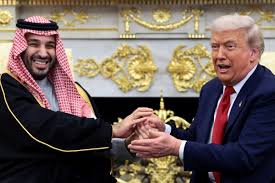
But a moment caught on camera during Donald Trump’s latest meeting with Saudi Crown Prince Mohammed bin Salman (MBS) has sparked a quiet storm — not because of what was said, but because of what was touched.
Millions saw the clip.
Very few understood what actually happened.
It began with Trump suddenly reaching out and grabbing MBS’s left hand, pulling him forward in a gesture that looked friendly on screen… but deeply uncomfortable up close.
The crown prince’s body stiffened. His smile froze. For a split second, the heir to one of the world’s most powerful kingdoms looked less like a statesman — and more like a man holding his breath.
Then Trump released his grip and joked loudly:
“I don’t care what I touched. I just grabbed it.”
The room tensed.
MBS withdrew his hand, eyes flicking down, and then — almost involuntarily — started rubbing his hands together, over and over, as if wiping off the moment.
To most viewers, it looked like a nervous habit.
To those familiar with Saudi royal customs, it was something else entirely.
Because in that 6-second exchange, Trump had unknowingly broken three major taboos — each one considered disrespectful in the Saudi context, and each one unmistakable to anyone aware of the kingdom’s protocols.
1. The First Mistake: Touching the Crown Prince Without Permission
In Saudi Arabia, the royal family is bound by strict etiquette.
The crown prince — especially one as high-ranked as MBS — is not supposed to be touched, let alone pulled, without a clear ceremonial purpose.
Spontaneous physical contact is unusual.
Grabbing is worse.
Pulling the left hand? Unthinkable.
For a leader who understands global protocol, Trump’s move was seen not as warm… but intrusive.
MBS’s quick retreat told the whole story.
2. The Second Mistake: Touching the “Unclean” Hand
Saudi custom traditionally considers the left hand unsuitable for formal gestures.
Meals, greetings, business — all are handled with the right hand.
So when Trump grabbed MBS’s left hand, it wasn’t merely awkward.
It crossed a cultural boundary with centuries of weight behind it.
Watching MBS rub his hands afterward suddenly feels different: it wasn’t nervousness — it was an attempt to regain dignity.
3. The Third Mistake: Turning Diplomacy Into a Punchline
Trump’s follow-up remark —
“I don’t care what I touched.” —
was the final blow.
To Western ears, it sounded like Trump being Trump.
To Saudi elites, it sounded like mockery during a formal diplomatic meeting.
Instead of mutual respect, the moment became a performance.
And the crown prince knew it.
A Moment That Revealed More Than Intended
For older viewers — Americans and Britons who grew up watching decades of presidential diplomacy — the clip is unsettling.
Not because of politics.
Not because of personality.
But because it showed something deeper:
How fragile respect can be. How quickly protocol can break. How easily a single gesture can shift the tone of an entire meeting.
Diplomacy is not built on treaties alone.
It’s built on manners — on understanding where another culture draws its lines.
And in those few seconds, Trump crossed all three.
🎬 Cellar Door (2024)
– Quando a porta do porão esconde mais do que segredos
Introdução
Lançado em novembro de 2024, Cellar Door é um thriller psicológico dirigido por Vaughn Stein (Terminal), estrelado por Jordana Brewster, Scott Speedman e Laurence Fishburne. Em vez de sustos fáceis ou efeitos grandiosos, o filme aposta em atmosfera densa, tensão doméstica e segredos sufocantes, explorando até onde um casal pode ir para proteger sua vida aparentemente perfeita.
Resumo da Trama
A história acompanha John (Scott Speedman) e Sera (Jordana Brewster), um casal em crise que se muda para uma casa isolada no campo, oferecida por um homem misterioso (Laurence Fishburne). Mas há uma condição: a porta da adega jamais deve ser aberta.
Logo, avisos enigmáticos começam a surgir — incluindo o de um antigo morador, que alerta para incendiar a casa antes que ela os destrua. Enquanto isso, a vida de John desmorona: um caso extraconjugal, um processo por assédio e o desaparecimento de sua amante Alyssa.
No clímax, Sera confessa que matou Alyssa em legítima defesa e convenceu John a esconder o corpo. Então, lança um ultimato perturbador: manter o segredo para salvar o casamento e a vida que construíram, ou revelar a verdade e perder tudo. O final ambíguo deixa no ar a reflexão sobre até onde somos capazes de ir para preservar amor, reputação e estabilidade.
Atuações

-
Jordana Brewster surpreende ao interpretar Sera com uma mistura de dor, culpa e frieza calculada.
-
Scott Speedman transmite bem a decadência de John, preso entre os próprios erros e a manipulação da esposa.
-
Laurence Fishburne, embora em papel menor, adiciona peso e mistério à narrativa.
Recepção
Apesar da premissa intrigante, Cellar Door recebeu críticas negativas, acumulando apenas 22% no Rotten Tomatoes. Muitos apontaram ritmo lento, excesso de diálogos expositivos e falta de impacto como thriller. Ainda assim, alguns viram valor no subtexto metafórico — a adega como símbolo dos segredos que insistimos em manter trancados.
Conclusão
Cellar Door (2024) não é o terror mais eficiente, mas funciona como um drama psicológico ambíguo, explorando a fragilidade das relações humanas e o peso dos segredos escondidos atrás de uma simples porta fechada.
⭐ Veredito Final: 5/10 – Um suspense irregular, porém curioso, que deixa mais perguntas do que respostas.